Cohortes
Des ensembles de personnes définis par ce qu'elles font ou ce qu'elles sont : chaque cohorte est un nom et une définition, et la définition est des clauses qui se lisent comme elles s'écrivent, a fait tel événement tant de fois en tant de jours, ou porte tel attribut à telle valeur. Une définition vide ne sélectionne personne, à dessein.
The library
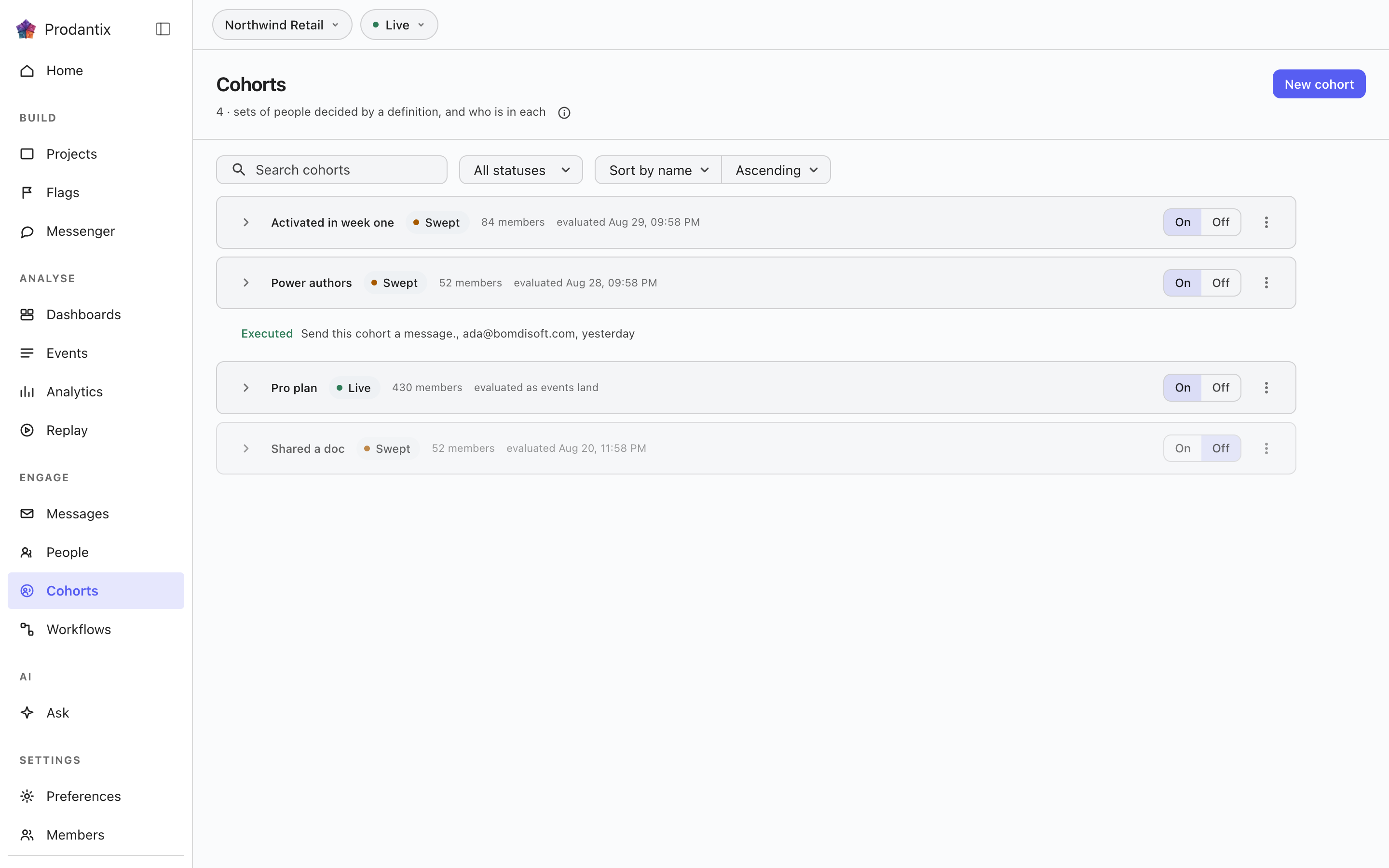
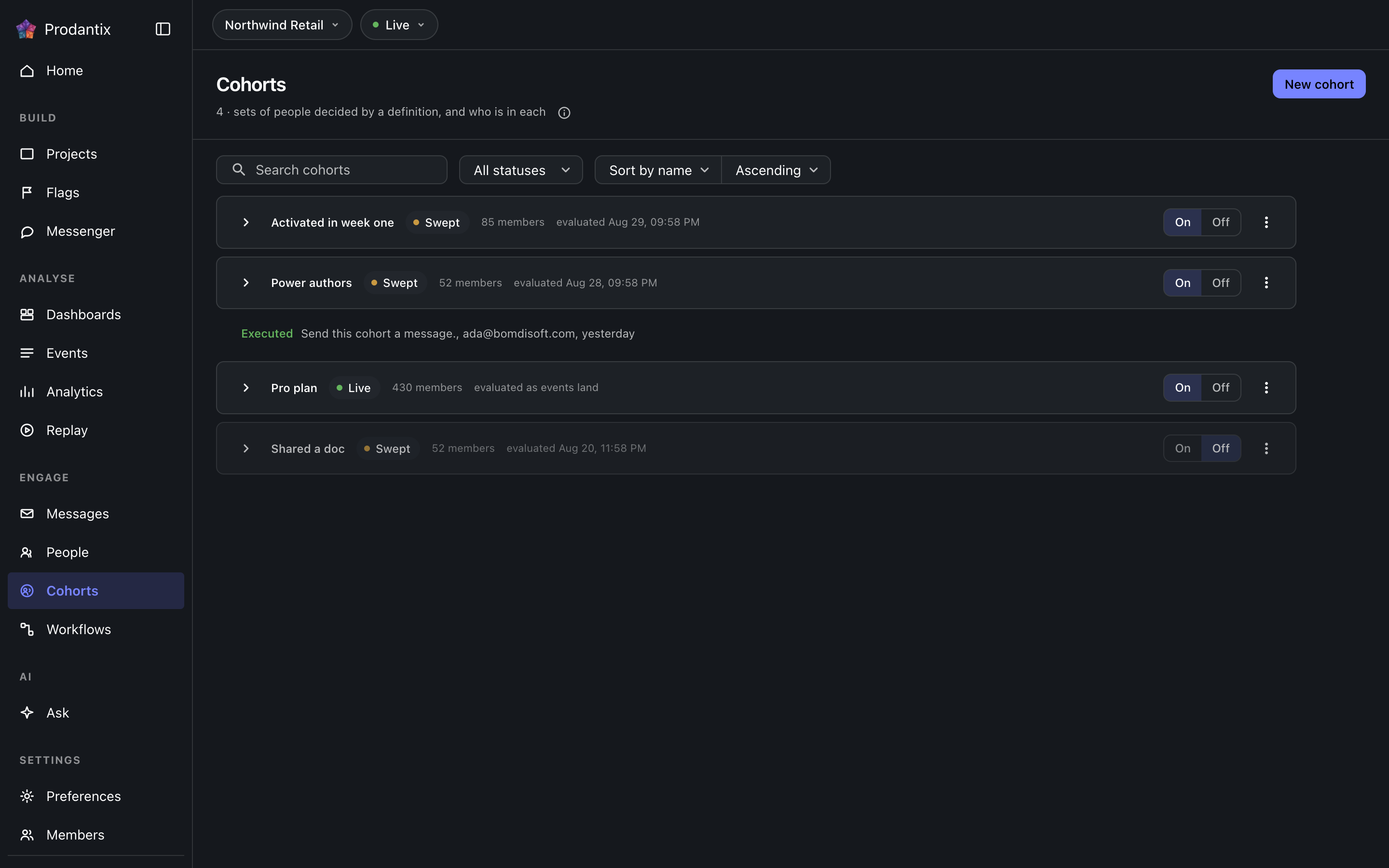
Each card is one cohort: its name, whether it is active, how many people it currently selects and how fresh that answer is. A cohort whose clauses count behaviour over history is swept on a schedule and says when it was last evaluated, or that it never has been; one defined purely by current attributes is live and carries no timestamp, because a timestamp would imply a staleness it does not have. The toolbar narrows by search, kind and state, and deleting asks first, warning that analyses filtered by the cohort stop being filtered by it.
Un troisième genre est statique : une liste fixe de personnes plutôt qu'une définition. Elle se garde d'un résultat sur l'atelier d'analyses par Save, ou se fabrique à partir d'une liste collée dans la boîte New cohort, et elle n'est jamais réévaluée, si bien que sa carte lit jamais, à dessein, là où une cohorte balayée porte un horodatage. L'ouvrir déplie la liste elle-même plutôt qu'une définition : combien de personnes elle tient, d'où vient la liste, Add people, et un retrait à côté de chaque ligne.
The definition editor


Opening a card unfolds its definition in place: behavioural clauses (did an event at least so many times within so many days, with the project's own event names suggested) and state clauses (an attribute compared to a value). A cohort is named first and defined after, and an empty definition selects nobody rather than everybody, which the open row says in as many words. Opening a second card does not close the first, so two definitions can be compared side by side without losing edits.
New cohort demande d'abord le nom, puis Membership, parce que les deux genres se fabriquent différemment et que la boîte qui nomme une cohorte est l'endroit où son genre se décide. Defined by rules donne la définition décrite plus haut. A fixed list of people révèle un champ pour les identifiants distincts, un par ligne, jusqu'à 10 000 d'un coup, et d'autres peuvent s'ajouter ensuite ; une cohorte faite ainsi naît avec ses personnes déjà dedans et active aussitôt.
Where cohorts are used
A cohort scopes a question in the Analytics workbench, targets a campaign in the Inbox, and gates workflow triggers on the Workflows screen. The same set of people, wherever the set is needed.
Copier vers… sur la ligne ouvre la copie de configuration avec cet objet déjà coché ; voir Projets, Copier la configuration.
Where this meets the API
The concept behind the screen is the People and cohorts pillar; the people being selected are the People directory. On the wire: the library is the cohorts query, cohort reads one and cohortMemberCount counts its people; editing is createCohort, updateCohort, setCohortActive and deleteCohort; a static cohort is born by createStaticCohort from a pasted list or by createCohortFromResult from a result, its list moves by addCohortMembers and removeCohortMembers, and cohortMembers reads it back a page at a time (GraphQL reference).
The definition as JSON
A rules cohort's definition is one JSON object, the definition argument of createCohort and updateCohort and the definition field of the MCP tools prodantix.cohorts.create and prodantix.cohorts.update. It holds clauses, a list of at most 32, and a person is a member when every clause matches. An empty list selects nobody. A field the shape does not name is refused, so read an existing cohort with cohort or prodantix.cohorts.get before changing one.
{
  "clauses": [
    { "kind": "state", "condition": { "attribute": "plan", "op": "eq", "value": "pro" } },
    { "kind": "state", "condition": { "attribute": "country", "op": "in", "value": ["DE", "AT", "CH"] } },
    { "kind": "behavioural", "event": "purchase", "atLeast": 3, "withinDays": 30 }
  ]
}
State clauses
{ "kind": "state", "condition": { ... } }. The condition names an attribute, one of the person's properties or distinct_id, an op and, for most operators, a value. The operators are eq, neq, in, not_in, contains, gt, gte, lt, lte, is_set, is_not_set. eq, neq and contains compare as text; gt, gte, lt and lte compare as numbers; in and not_in take a list of values; is_set and is_not_set take none, and a property that is empty text counts as not set. A cohort made only of state clauses is live: a person joins or leaves the moment an event changes the property. The two cohort operators of flag targeting, in_cohort and not_in_cohort, are refused here: a cohort cannot be defined by another cohort.
Behavioural clauses
{ "kind": "behavioural", "event": "purchase", "atLeast": 3, "withinDays": 30 }: the person did the event at least atLeast times in the last withinDays days. Both are whole numbers, and a person counts only once they did the event at all, so an atLeast of 0 reads as 1. One behavioural clause makes the cohort swept: its members are worked out on a schedule rather than as events land, and the cohort says when it last was.
Static cohorts
A static cohort's definition is { "kind": "static", "clauses": [] }: its members are a list somebody wrote, not rules. Given to createCohort it makes an empty list; createStaticCohort or prodantix.cohorts.create_static makes one holding its people, and createCohortFromResult makes one from a result. An update cannot turn a rules cohort into a static one or back; make a new cohort of the kind you want.