Kohorten
Mengen von Menschen, definiert durch das, was sie tun oder was sie sind: Jede Kohorte ist ein Name und eine Definition, und die Definition sind Klauseln, die sich lesen wie geschrieben: hat dieses Ereignis so oft in so vielen Tagen getan, oder trägt dieses Attribut mit diesem Wert. Eine leere Definition wählt niemanden, mit Absicht.
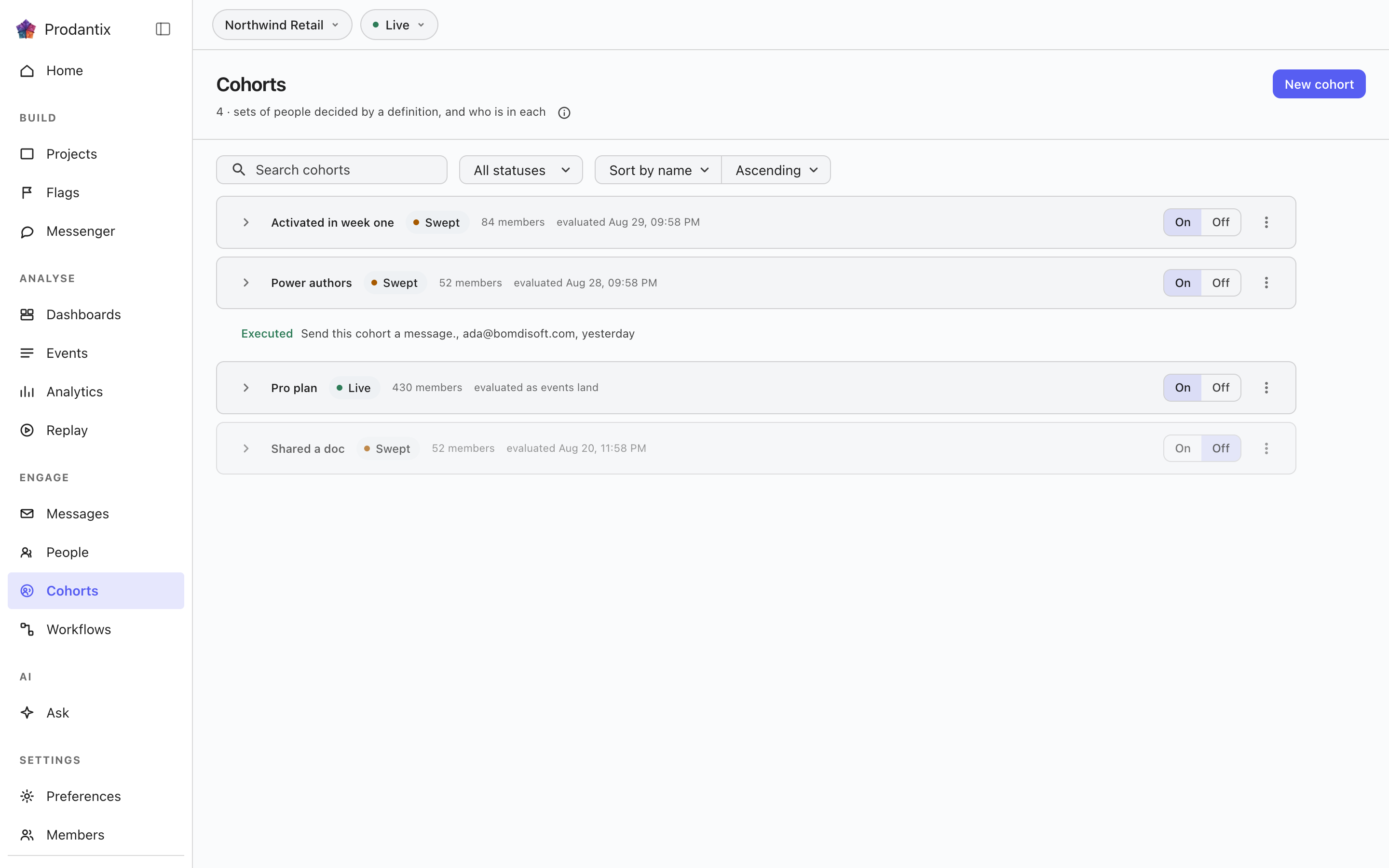
The library
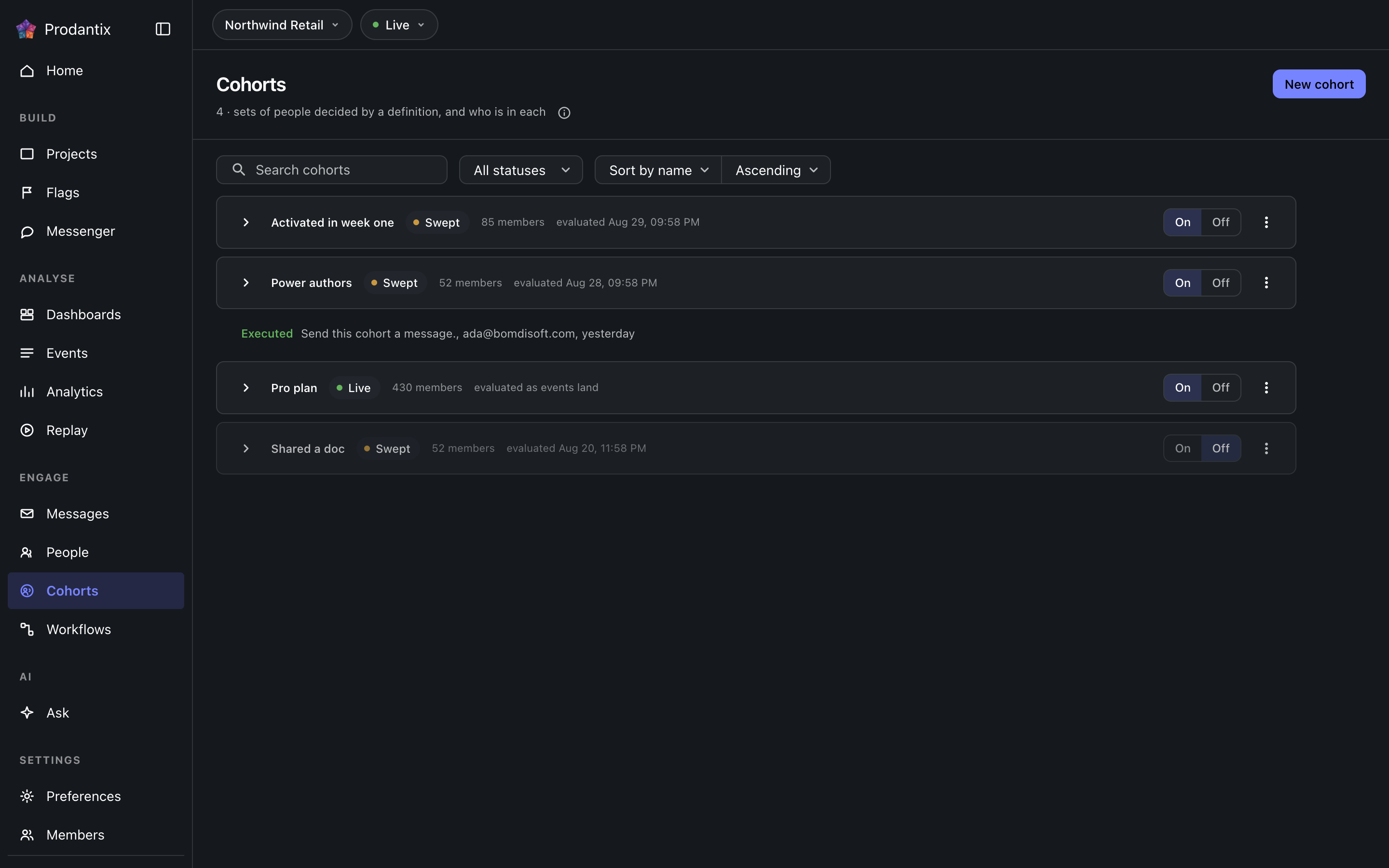
Each card is one cohort: its name, whether it is active, how many people it currently selects and how fresh that answer is. A cohort whose clauses count behaviour over history is swept on a schedule and says when it was last evaluated, or that it never has been; one defined purely by current attributes is live and carries no timestamp, because a timestamp would imply a staleness it does not have. The toolbar narrows by search, kind and state, and deleting asks first, warning that analyses filtered by the cohort stop being filtered by it.
Eine dritte Art ist statisch: eine feste Liste von Menschen statt einer Definition. Sie wird auf der Analysen-Werkbank über Save aus einem Ergebnis behalten oder im Dialog New cohort aus einer eingefügten Liste gemacht, und sie wird nie neu ausgewertet, sodass ihre Karte nie, mit Absicht liest, wo eine gekehrte Kohorte einen Zeitstempel trägt. Das Öffnen faltet die Liste selbst auf statt einer Definition: wie viele Menschen sie hält, woher die Liste kam, Add people und ein Entfernen neben jeder Zeile.
The definition editor


Opening a card unfolds its definition in place: behavioural clauses (did an event at least so many times within so many days, with the project's own event names suggested) and state clauses (an attribute compared to a value). A cohort is named first and defined after, and an empty definition selects nobody rather than everybody, which the open row says in as many words. Opening a second card does not close the first, so two definitions can be compared side by side without losing edits.
New cohort fragt zuerst nach dem Namen und dann nach Membership, weil die beiden Arten unterschiedlich gemacht werden und der Dialog, der eine Kohorte benennt, der Ort ist, an dem ihre Art entschieden wird. Defined by rules gibt die oben beschriebene Definition. A fixed list of people gibt ein Feld für die Distinct-IDs frei, eine pro Zeile, bis zu 10.000 auf einmal, und weitere lassen sich später hinzufügen; eine so gemachte Kohorte wird mit ihren Menschen darin geboren und ist sofort aktiv.
Where cohorts are used
A cohort scopes a question in the Analytics workbench, targets a campaign in the Inbox, and gates workflow triggers on the Workflows screen. The same set of people, wherever the set is needed.
Kopieren nach… in der Zeile öffnet das Kopieren der Konfiguration mit diesem Objekt bereits angehakt; siehe Projekte, Konfiguration kopieren.
Where this meets the API
The concept behind the screen is the People and cohorts pillar; the people being selected are the People directory. On the wire: the library is the cohorts query, cohort reads one and cohortMemberCount counts its people; editing is createCohort, updateCohort, setCohortActive and deleteCohort; a static cohort is born by createStaticCohort from a pasted list or by createCohortFromResult from a result, its list moves by addCohortMembers and removeCohortMembers, and cohortMembers reads it back a page at a time (GraphQL reference).
The definition as JSON
A rules cohort's definition is one JSON object, the definition argument of createCohort and updateCohort and the definition field of the MCP tools prodantix.cohorts.create and prodantix.cohorts.update. It holds clauses, a list of at most 32, and a person is a member when every clause matches. An empty list selects nobody. A field the shape does not name is refused, so read an existing cohort with cohort or prodantix.cohorts.get before changing one.
{
  "clauses": [
    { "kind": "state", "condition": { "attribute": "plan", "op": "eq", "value": "pro" } },
    { "kind": "state", "condition": { "attribute": "country", "op": "in", "value": ["DE", "AT", "CH"] } },
    { "kind": "behavioural", "event": "purchase", "atLeast": 3, "withinDays": 30 }
  ]
}
State clauses
{ "kind": "state", "condition": { ... } }. The condition names an attribute, one of the person's properties or distinct_id, an op and, for most operators, a value. The operators are eq, neq, in, not_in, contains, gt, gte, lt, lte, is_set, is_not_set. eq, neq and contains compare as text; gt, gte, lt and lte compare as numbers; in and not_in take a list of values; is_set and is_not_set take none, and a property that is empty text counts as not set. A cohort made only of state clauses is live: a person joins or leaves the moment an event changes the property. The two cohort operators of flag targeting, in_cohort and not_in_cohort, are refused here: a cohort cannot be defined by another cohort.
Behavioural clauses
{ "kind": "behavioural", "event": "purchase", "atLeast": 3, "withinDays": 30 }: the person did the event at least atLeast times in the last withinDays days. Both are whole numbers, and a person counts only once they did the event at all, so an atLeast of 0 reads as 1. One behavioural clause makes the cohort swept: its members are worked out on a schedule rather than as events land, and the cohort says when it last was.
Static cohorts
A static cohort's definition is { "kind": "static", "clauses": [] }: its members are a list somebody wrote, not rules. Given to createCohort it makes an empty list; createStaticCohort or prodantix.cohorts.create_static makes one holding its people, and createCohortFromResult makes one from a result. An update cannot turn a rules cohort into a static one or back; make a new cohort of the kind you want.