Nhóm người dùng
Các tập hợp người được định nghĩa bởi việc họ làm hoặc con người họ: mỗi nhóm là một cái tên và một định nghĩa, và định nghĩa là các mệnh đề đọc đúng như viết: đã làm sự kiện này bao nhiêu lần trong bao nhiêu ngày, hoặc có thuộc tính này với giá trị này. Định nghĩa rỗng không chọn ai cả, đó là chủ ý.
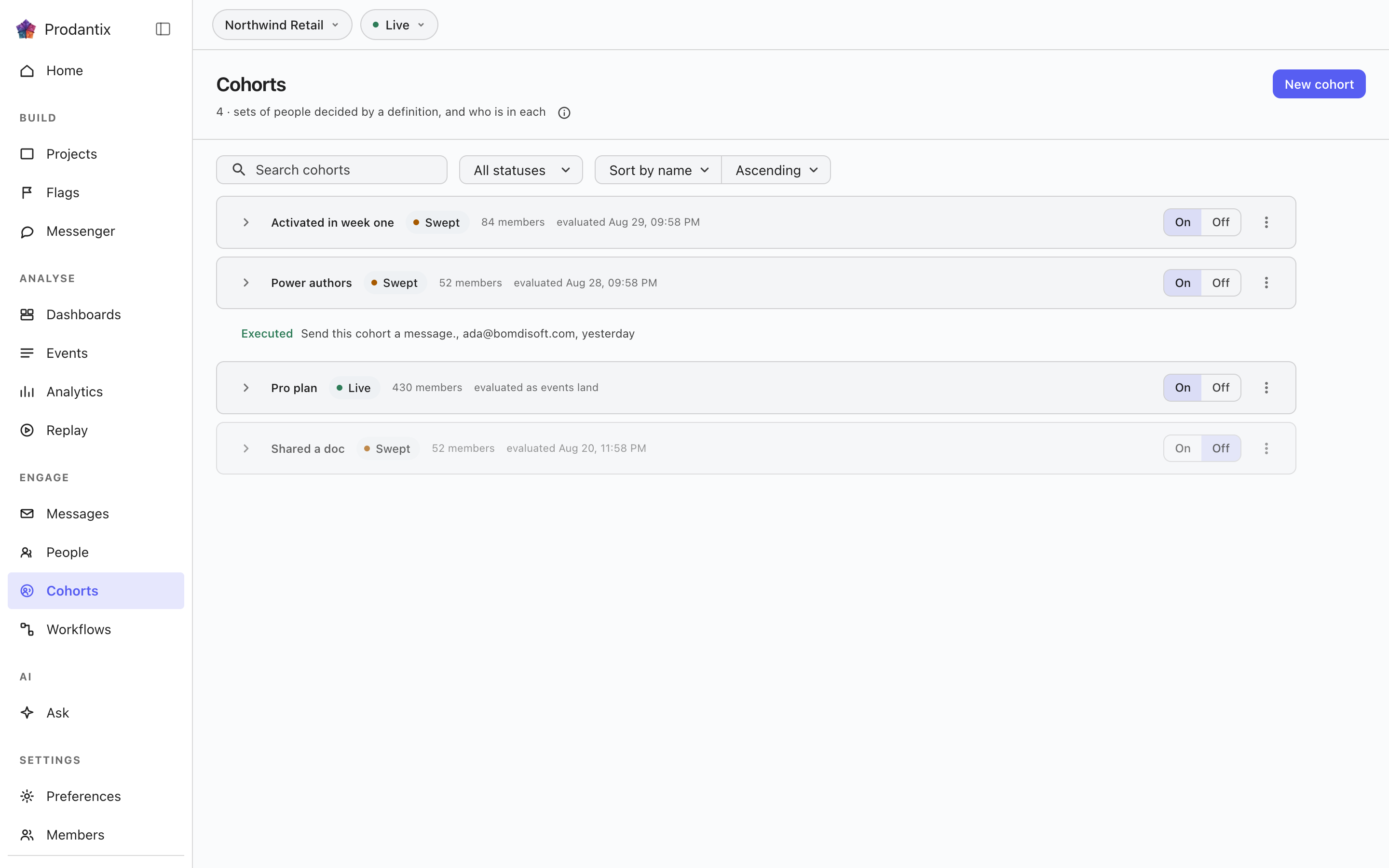
The library
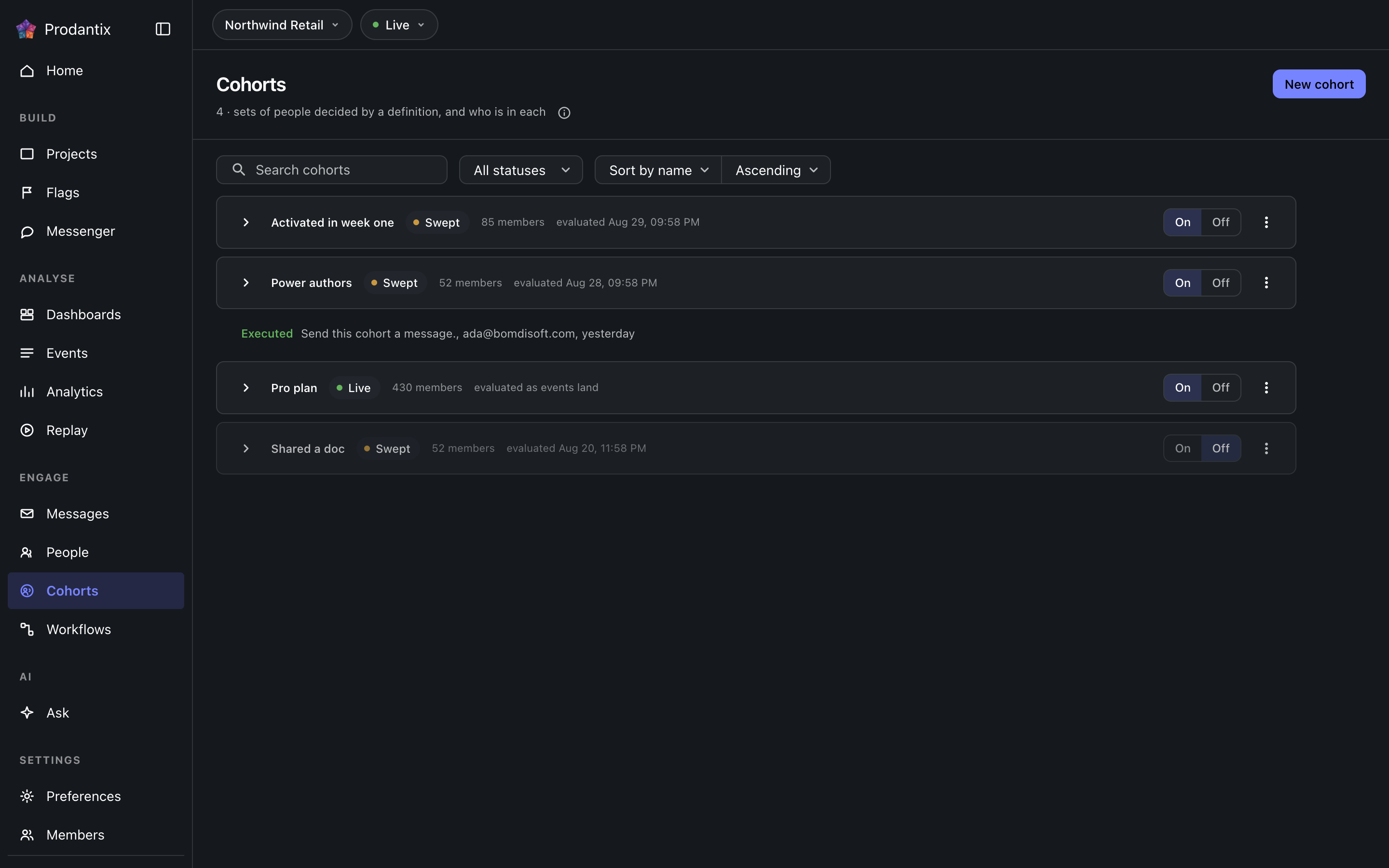
Each card is one cohort: its name, whether it is active, how many people it currently selects and how fresh that answer is. A cohort whose clauses count behaviour over history is swept on a schedule and says when it was last evaluated, or that it never has been; one defined purely by current attributes is live and carries no timestamp, because a timestamp would imply a staleness it does not have. The toolbar narrows by search, kind and state, and deleting asks first, warning that analyses filtered by the cohort stop being filtered by it.
Có một loại thứ ba, tĩnh: một danh sách người cố định thay vì một định nghĩa. Nó được giữ lại từ một kết quả trên bàn làm việc phân tích qua Save, hoặc được tạo từ một danh sách dán vào hộp thoại New cohort, và nó không bao giờ được đánh giá lại, nên ở chỗ một nhóm được quét mang dấu thời gian thì thẻ của nó ghi chưa bao giờ, đó là chủ ý. Mở ra thì chính danh sách được trải ra chứ không phải một định nghĩa: nó giữ bao nhiêu người, danh sách đến từ đâu, Add people, và một nút gỡ bên cạnh mỗi hàng.
The definition editor


Opening a card unfolds its definition in place: behavioural clauses (did an event at least so many times within so many days, with the project's own event names suggested) and state clauses (an attribute compared to a value). A cohort is named first and defined after, and an empty definition selects nobody rather than everybody, which the open row says in as many words. Opening a second card does not close the first, so two definitions can be compared side by side without losing edits.
Hộp thoại New cohort hỏi tên trước rồi mới hỏi Membership, vì hai loại được tạo theo hai cách khác nhau và chính hộp thoại đặt tên cho một nhóm là nơi quyết định loại của nó. Defined by rules cho định nghĩa đã mô tả ở trên. A fixed list of people mở ra một ô cho các distinct id, mỗi dòng một mã, tối đa 10.000 mỗi lần, và có thể thêm nữa về sau; một nhóm tạo theo cách đó ra đời cùng với những người của nó và hoạt động ngay.
Where cohorts are used
A cohort scopes a question in the Analytics workbench, targets a campaign in the Inbox, and gates workflow triggers on the Workflows screen. The same set of people, wherever the set is needed.
Sao chép sang… trên hàng sẽ mở phần sao chép cấu hình với đối tượng này đã được đánh dấu; xem Dự án, Sao chép cấu hình.
Where this meets the API
The concept behind the screen is the People and cohorts pillar; the people being selected are the People directory. On the wire: the library is the cohorts query, cohort reads one and cohortMemberCount counts its people; editing is createCohort, updateCohort, setCohortActive and deleteCohort; a static cohort is born by createStaticCohort from a pasted list or by createCohortFromResult from a result, its list moves by addCohortMembers and removeCohortMembers, and cohortMembers reads it back a page at a time (GraphQL reference).
The definition as JSON
A rules cohort's definition is one JSON object, the definition argument of createCohort and updateCohort and the definition field of the MCP tools prodantix.cohorts.create and prodantix.cohorts.update. It holds clauses, a list of at most 32, and a person is a member when every clause matches. An empty list selects nobody. A field the shape does not name is refused, so read an existing cohort with cohort or prodantix.cohorts.get before changing one.
{
  "clauses": [
    { "kind": "state", "condition": { "attribute": "plan", "op": "eq", "value": "pro" } },
    { "kind": "state", "condition": { "attribute": "country", "op": "in", "value": ["DE", "AT", "CH"] } },
    { "kind": "behavioural", "event": "purchase", "atLeast": 3, "withinDays": 30 }
  ]
}
State clauses
{ "kind": "state", "condition": { ... } }. The condition names an attribute, one of the person's properties or distinct_id, an op and, for most operators, a value. The operators are eq, neq, in, not_in, contains, gt, gte, lt, lte, is_set, is_not_set. eq, neq and contains compare as text; gt, gte, lt and lte compare as numbers; in and not_in take a list of values; is_set and is_not_set take none, and a property that is empty text counts as not set. A cohort made only of state clauses is live: a person joins or leaves the moment an event changes the property. The two cohort operators of flag targeting, in_cohort and not_in_cohort, are refused here: a cohort cannot be defined by another cohort.
Behavioural clauses
{ "kind": "behavioural", "event": "purchase", "atLeast": 3, "withinDays": 30 }: the person did the event at least atLeast times in the last withinDays days. Both are whole numbers, and a person counts only once they did the event at all, so an atLeast of 0 reads as 1. One behavioural clause makes the cohort swept: its members are worked out on a schedule rather than as events land, and the cohort says when it last was.
Static cohorts
A static cohort's definition is { "kind": "static", "clauses": [] }: its members are a list somebody wrote, not rules. Given to createCohort it makes an empty list; createStaticCohort or prodantix.cohorts.create_static makes one holding its people, and createCohortFromResult makes one from a result. An update cannot turn a rules cohort into a static one or back; make a new cohort of the kind you want.